Málaga is one of the best bases in Spain for day trips. The city sits at the heart of Andalusia, within easy reach of world-class monuments, dramatic natural landscapes, historic white villages, and destinations that cross continents. Granada, Ronda, the Caminito del Rey, or even Morocco are all reachable in a single day.
This guide covers the best day trips from Málaga, organised by type of experience. For each destination, you will find what makes it worth the journey, how to get there, and the option to book a guided tour — where transport, expert commentary, and entry tickets to monuments are all included.
Day trips from Málaga — quick overview
Andalusia is home to three of the most visited cities in Spain: Granada, Seville, and Córdoba. All three are within comfortable reach of Málaga for a day trip. Each city has a distinct character, and each holds monuments that are genuinely unmissable.
Granada is the most in-demand day trip from Málaga. The reason is the Alhambra: a Nasrid palace complex on a hilltop above the city, considered one of the finest examples of Islamic architecture in the world. Its sculpted plasterwork, reflecting pools, and Generalife gardens are unlike anything else in Europe.
Access to the Nasrid Palaces — the highlight of the complex — is strictly limited by timed entry slots. Tickets sell out weeks in advance, especially in spring and summer. Guided tours to Granada include the Alhambra entrance ticket, so there is no risk of arriving and finding it sold out. The tour also covers the Albaicín quarter, a UNESCO-listed Moorish neighbourhood of cobbled lanes and viewpoints above the city.
Seville is the capital of Andalusia and one of the great cities of southern Europe. The historic centre holds three unmissable landmarks: the Catedral de Sevilla — the largest Gothic cathedral in the world, with the tomb of Christopher Columbus inside — the Real Alcázar, a UNESCO-listed royal palace with extraordinary Moorish gardens, and the sweeping Plaza de España, built for the 1929 Ibero-American Exposition.
Seville is about 200 km from Málaga, but the high-speed AVE train makes the journey under 2 hours each way. Guided tours include return transport and a walking tour of the historic centre, with the Cathedral and Alcázar visit included. This removes both the logistics and the risk of long walk-in queues at the monuments.

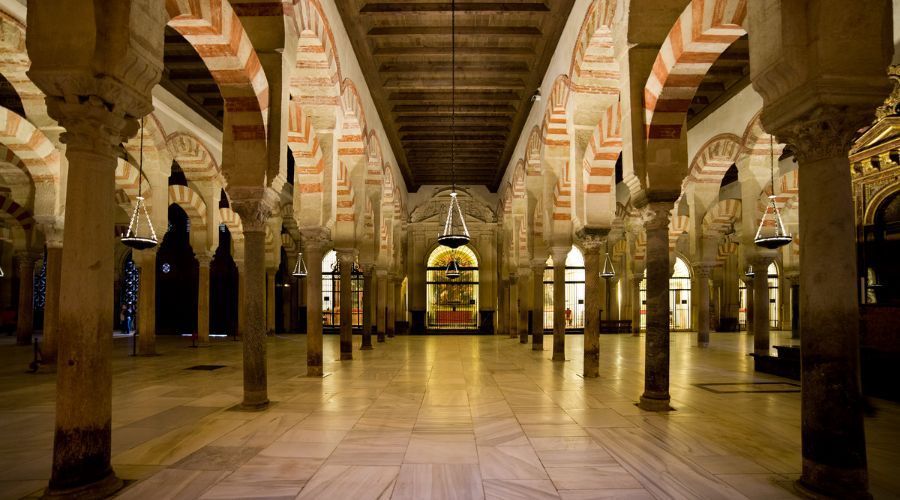
Córdoba is often overlooked in favour of Granada or Seville. That is a mistake. The Mezquita-Catedral is one of the most extraordinary buildings in the world: a vast 10th-century mosque of 856 columns and red-and-white horseshoe arches, with a complete 16th-century Christian cathedral built into its very centre. No photograph prepares you for it.
Surrounding the mosque, the Judería (Jewish Quarter) is a labyrinth of whitewashed lanes, flower-filled courtyards, and Roman-era streets. In May, private patios across the city open to the public for the Festival de los Patios — a UNESCO-listed tradition. Guided tours include the Mezquita entrance ticket and a guided walk of both the mosque and the Judería.
The province of Málaga is surrounded by pueblos blancos — whitewashed villages perched on hilltops and cliff edges. These trips offer a very different Andalusia from the grand cities: quieter, more intimate, and often more visually surprising.
Ronda is built on a clifftop split by a 120-metre gorge. The 18th-century Puente Nuevo bridge spans the void between two halves of the town. Standing on that bridge, looking down into the Tajo gorge, is one of the most memorable views in Spain. The old town holds Andalusia’s oldest bullring, a Moorish bathhouse, Arab baths, and medieval streets perfect for exploring on foot.
Many tours combine Ronda with Setenil de las Bodegas, a village 20 km away where houses and shops are built directly into the overhanging rock face of a gorge. It is one of the most unusual streetscapes in Spain. The tour includes return transport from Málaga and guided visits to both towns. Combining the two by public transport independently would not be practical.
Nerja is a coastal town one hour east of Málaga. It is known for the Balcón de Europa — a clifftop promenade with panoramic Mediterranean views — and its beaches, including the secluded Playa de Maro. Below the town, the Cuevas de Nerja contain 5,000-year-old cave paintings and one of the largest known stalactite formations in the world.
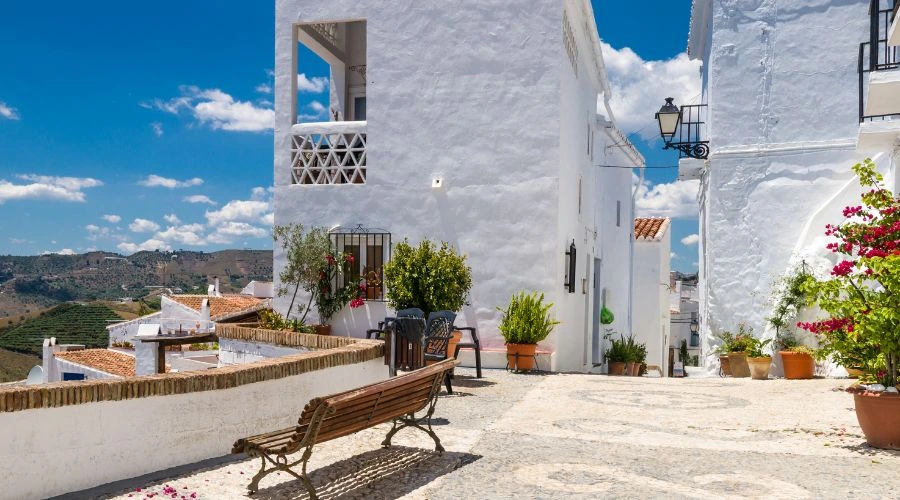
Just 6 km inland, Frigiliana has been voted one of the most beautiful villages in Spain multiple times. Its Moorish upper quarter is a steep maze of cobbled lanes, ceramic-tiled walls, and potted geraniums, with views over the surrounding hills. The tour includes return transport, a guided visit to both Nerja and Frigiliana, and the Nerja Caves entrance ticket.
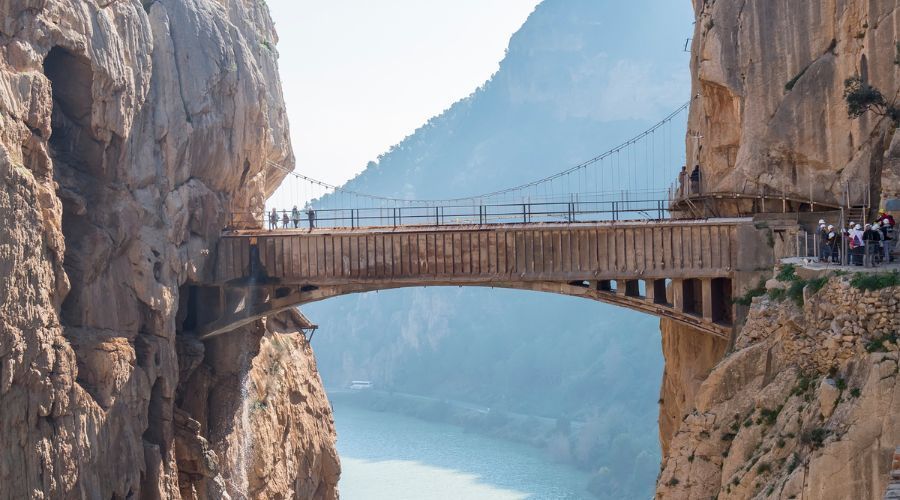
The Caminito del Rey is a 7.7 km walkway built into the vertical walls of the El Chorro gorge, suspended above the Guadalhorce river. Originally constructed in the early 20th century for hydroelectric workers, it was fully restored in 2015 and is now one of the most spectacular walking routes in Spain — and one of the most popular, with strictly limited daily places.
The route is one-way through the gorge. The path is well-maintained with safety railings and does not require technical climbing skills. However, a good level of fitness and comfort with heights are recommended. The tour includes return transport from Málaga, the Caminito del Rey entry ticket, and a guide for the walk. This is also the most practical way to manage the logistics of a one-way route — both ends of the path are included in the transport.
Two of the most unique day trips from Málaga take you outside Spain entirely. One crosses into a British Overseas Territory at the tip of Europe. The other crosses the Strait of Gibraltar into North Africa. Both are experiences that cannot be replicated anywhere else.
Gibraltar is a British Overseas Territory at the southern tip of the Iberian Peninsula. Its defining feature is the Rock of Gibraltar — a 426-metre limestone monolith overlooking the strait between Europe and Africa. The Upper Rock Nature Reserve is home to Barbary macaques (the only wild monkeys in Europe), St. Michael’s Cave with its dramatic stalactite chambers, and the Great Siege Tunnels carved into the rock during the 18th-century siege.
Gibraltar has a unique character: British pubs and phone boxes, Spanish tapas bars, and a distinct Genoese and Moorish heritage all coexist on two square kilometres of rock. The guided tour from Málaga includes return transport and the cable car ticket to the Top of the Rock, where views extend across two continents on a clear day.

The Morocco day trip from Málaga is one of the most remarkable excursions available from any European city. In a single day, you travel from Andalusia by coach to Tarifa, cross the Strait of Gibraltar by ferry, and arrive in North Africa. The destination is Tétouan — the former capital of Spanish Morocco — whose UNESCO-listed medina blends Moorish, Berber, and Andalusian architecture in a way found nowhere else.
The guided tour covers the medina’s covered souks, artisan workshops, the Royal Palace square, and time to explore the market stalls and taste traditional Moroccan food. All transport is included: coach to Tarifa, ferry crossing, border formalities, and road transport to Tétouan. This is the recommended way to do this trip — the logistics across two borders and two countries are complex to manage independently.

For some destinations, independent travel by train or bus is straightforward. Granada, Seville, and Córdoba are all served by direct RENFE trains from Málaga María Zambrano station. The trains are fast, comfortable, and frequent.
For other destinations, a guided tour is the more practical choice — and often more economical when you include transport, entry tickets, and local guiding in the comparison. The Caminito del Rey is a one-way route that requires managing transport to both ends of the path. Ronda combined with Setenil is not practical by public transport. Gibraltar and Morocco involve border crossings and complex logistics that a guided tour handles entirely.
The key advantage of any guided excursion from Málaga is that entry tickets to monuments are included — the Alhambra, the Mezquita-Catedral, the Caminito del Rey path, the Nerja Caves. Booking these independently requires planning weeks ahead, especially for the Alhambra.
Spring (March–May) is the best season for most day trips. Temperatures are comfortable, wildflowers cover the countryside, and the Caminito del Rey is at its most beautiful. Autumn (September–November) is equally good, with fewer visitors and pleasant weather. Summer (June–August) is very hot inland — Granada, Seville, and Córdoba can reach 40°C. Coastal destinations like Nerja are more comfortable in summer. Winter (December–February) is ideal for city visits: far fewer crowds, mild temperatures on the coast, and monuments no less impressive.
The most popular day trip from Málaga is Granada and the Alhambra. The Nasrid Palaces are among the most spectacular monuments in Europe, and tickets sell out far in advance — a guided tour that includes the entrance ticket removes that problem. For outdoor adventure, the Caminito del Rey gorge walk is outstanding. Ronda, with its clifftop setting above the Tajo gorge, is another top choice.
Yes. Granada, Seville, and Córdoba are all served by direct RENFE trains from Málaga María Zambrano station. Nerja is reached by ALSA bus in about one hour. For destinations where public transport is impractical — the Caminito del Rey, Ronda combined with Setenil, Gibraltar, and Morocco — a guided tour is the most practical car-free option as all transport is fully included.
Yes. Guided day tours include return transport and entry tickets to the key monuments — the Alhambra Nasrid Palaces in Granada, the Mezquita-Catedral in Córdoba, the Caminito del Rey, and the Nerja Caves. This is one of the main reasons to book a guided excursion rather than travelling independently.
The Nasrid Palaces at the Alhambra sell out weeks or months ahead in spring and summer. Book as early as possible if you plan to visit independently. Guided tours to Granada include the Alhambra entrance ticket — this is the safest way to guarantee access.
Granada and Seville are the easiest city day trips by train. Direct RENFE trains from Málaga María Zambrano reach Granada in about 1 hour 20 minutes and Seville in under 2 hours. Córdoba takes approximately 1 hour by high-speed AVE. All three are excellent city day trips by train.
Yes. The AVE train reaches Seville in under 2 hours, and the city is home to the world’s largest Gothic cathedral, the UNESCO-listed Real Alcázar, and the Plaza de España. An early departure gives you a full day before returning in the evening. Guided day trips include transport and a walking tour of the historic centre.
Nerja and Frigiliana are ideal for families — the Balcón de Europa, beautiful beaches, and Nerja Caves appeal to all ages. The Caminito del Rey suits children from about 8 years old who are comfortable with heights. For older children and teenagers, Morocco is an unforgettable cultural experience unlike anything in Europe.

About the author — Edu Ballesteros
Edu Ballesteros is an Andalusian travel expert and the founder of Málaga Sightseeing. Born and raised in Andalusia, he has spent years exploring the region first-hand — from the Alhambra’s Nasrid Palaces to the gorges of the Caminito del Rey — and has made it his mission to help visitors discover the very best of his homeland. Málaga Sightseeing was created from that passion: a locally-rooted guide to the Costa del Sol and Andalusia’s most remarkable destinations.
Browse the full selection of guided day excursions from Málaga. All tours include comfortable return transport and professional English-speaking guides. Entry tickets to monuments are included where indicated.